Product Overview
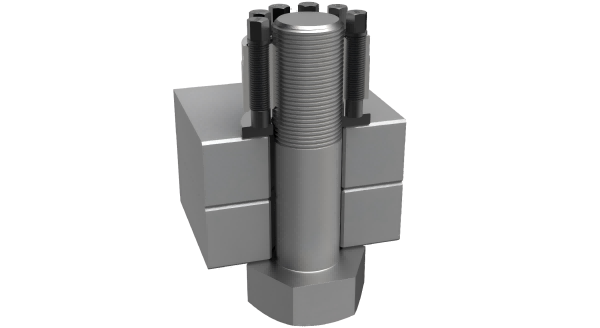
Standard Super Nut is the most widely used type of super nut, mainly used to replace traditional high-strength hex nuts, providing stable and reliable preloading and anti-loosening performance under conventional industrial conditions.
Structural Features
- Super nut, also known as multi‑stage jacking nut, consists of a central nut, a ring of satellite jacking bolts around it, and a hard washer.
- There is another type of super bolt, which is composed of a central bolt, a ring of satellite jacking bolts around it, and a hard washer.
- The first type of super nut is sometimes also referred to as a super bolt. Its formal definition is a jacking tensioning device, which can be directly used to replace existing hex nuts for easy identification.
Working Principle of the Super Nut
- By tightening the jacking bolts, a large axial jacking force is generated. The jacking force acts directly on the hard washer. Due to the small friction diameter of the jacking bolts, a large jacking force can be achieved with a relatively small torque.
- The load is transferred to the nut body that has been manually installed on the main bolt.
- The hard washer is used to transmit the thrust while protecting the flange face.
- The axial jacking forces from several jacking bolts, together with the reaction force from the main bolt head, generate a huge clamping force on the flange.
- The axial jacking force of the jacking bolts produces an equivalent tensile force on the main bolt.
Excessive tightening force of ordinary bolts often results in thread galling (metal seizing). It can be observed that thread galling mostly occurs on the lower two or three threads of the nut, which is caused by stress concentration due to excessive preload.
The stress relief function is another major feature of the super nut. The interaction between the forces from the jacking bolts and the main bolt creates a bending moment, which is distributed circumferentially on the super nut, thus generating circumferential stress.
The circumferential stress causes the lower diameter of the super nut to increase and the upper diameter to decrease. This expansion and contraction movement relieves stress concentration, improves static load capacity, and prevents thread galling (metal seizing).